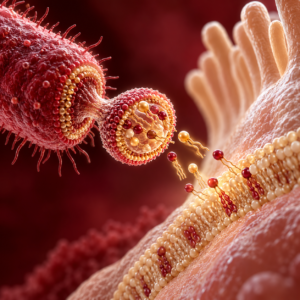
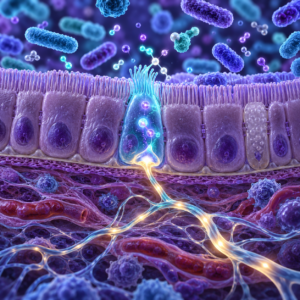
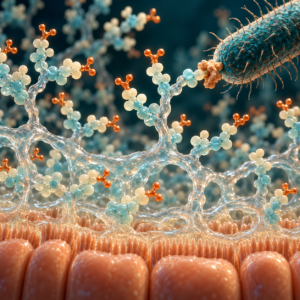
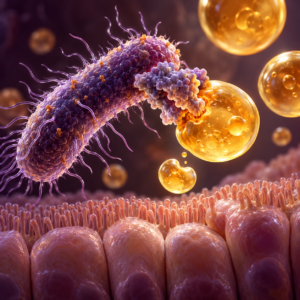
The mucus lining the colon is more than a passive gel. It is both a protective barrier and a carefully managed food source for certain gut microbes. Its main protein, called MUC2, is covered with branching sugar chains. Many of those sugars carry sulfate groups that work like chemical locks. They make the chains harder to break apart and help control which microbes can reach the nutrients underneath.
That means mucus is doing two jobs at once. It separates most bacteria from the intestinal surface, and it supplies a renewable habitat for organisms adapted to live on host-derived carbohydrates. Recent work makes the tension between those jobs unusually clear. Sulfation can protect the barrier, while specialized microbial sulfatases can unlock it. Whether that exchange supports normal renewal or excessive erosion depends on the enzymes involved, the surrounding microbial community, and the availability of dietary fiber.
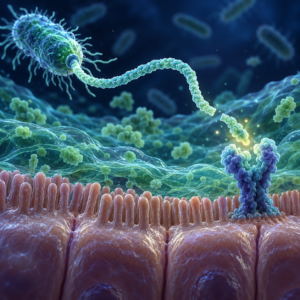
Mucus sugars are built in layers. A bacterium cannot consume the whole structure with one enzyme. It needs a coordinated set of tools that removes the outer chemical groups, cuts particular bonds, and exposes the next layer. Sulfate is one of the first barriers that some microbes must remove.
A large study of Akkermansia muciniphila found dozens of enzymes that work together to take mucus sugars apart step by step. Some remove sulfate, while others cut the exposed sugar bonds. The same toolkit can act on several sugars made by the host. This shows that mucus feeding is not one reaction. It is a staged digestive process (Bakshani et al., 2025).
The full analysis in The Weekly Biome examines how intestinal cells strengthen these chemical locks, how microbial enzymes remove them, and why dietary fiber and community activity help determine the balance between mucus renewal and breakdown.