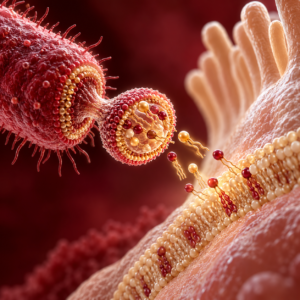
Flagellin is the protein building block of a bacterial flagellum, the rotating tail that lets many bacteria move. The immune system detects flagellin with a sensor called Toll-like receptor 5, or TLR5. This basic description can lead to a misleading shortcut: flagellin always means inflammation. Research in the intestine shows why that is not true.
Some flagellins from helpful gut bacteria bind TLR5 but barely turn it on. A local flagellin signal can call in immune cells that help repair the intestinal lining. Too little TLR5 surveillance can allow moving bacteria to enter the mucus layer. In another location or disease state, a stronger and longer signal can add to inflammation throughout the body. The protein’s shape, amount, location, and surrounding tissue all matter.
A 2023 study found a class of “silent” flagellins from common gut bacteria. TLR5 recognized these proteins, but they turned the receptor on only weakly. The reason was structural: they lacked a second point of contact that normally helps two TLR5 molecules form a stable signaling pair. Researchers saw the same weak response in human mini-gut tissue models and in mice. They also found silent flagellins in human stool. Many came from Lachnospiraceae, a common family of gut bacteria. (Clasen et al., 2023)
This finding replaces an on-or-off model with a volume control. TLR5 can bind a flagellin without producing the response caused by a strongly stimulating version. A small change outside the main binding site can greatly alter the signal. The immune system is reading details in the protein’s shape, not merely checking whether a flagellum is present.
The full analysis in The Weekly Biome examines silent and strongly stimulating flagellins, local barrier-supportive responses, and the conditions in which the same microbial signal can contribute to wider inflammation.