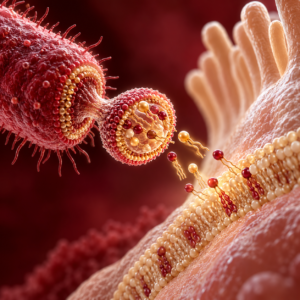
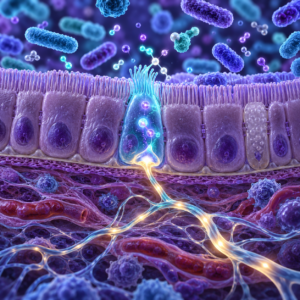
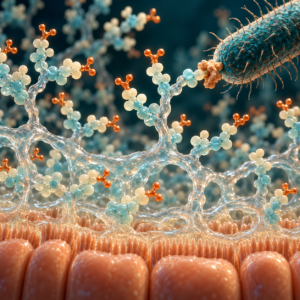
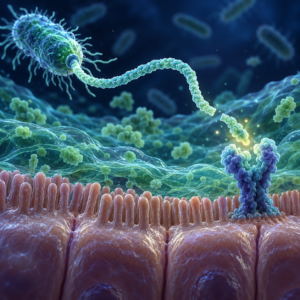
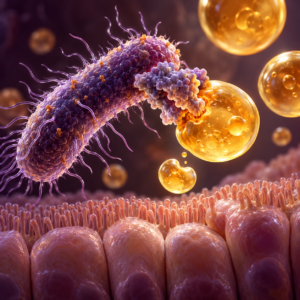
A bacterium does not need to stay in the intestine, or even remain intact, to leave a biological signal behind. Many bacteria release tiny bubbles made from their outer covering. Scientists call these particles extracellular vesicles. Each vesicle can carry a small collection of bacterial molecules, allowing material from the microbe to travel without the whole cell.
This adds a new possibility to probiotic research. Most conventional probiotics pass through the gut rather than becoming permanent residents, but they can still act while they are present. Vesicles may be one way that a passing bacterium reaches the intestinal lining or communicates with immune cells. The mechanism is plausible and measurable. It is not yet a proven human treatment because the current evidence comes mainly from cell cultures and animal models.
A vesicle is surrounded by a membrane, the same type of thin boundary that encloses a bacterial cell. That membrane can protect the molecules inside and influence where the package travels. The cargo may include proteins, fats, fragments of the bacterial wall, genetic material, and small chemical products. Because the contents come from the producing bacterium, vesicles from different bacteria do not carry identical messages.
A comparative study examined vesicles released by three bacteria used or studied as probiotics: Bifidobacterium longum, Clostridium butyricum, and Lactobacillus plantarum WCFS1. Their vesicles differed in quantity, but many were roughly 100 to 150 nanometers wide, far smaller than a bacterial cell. Two types of mouse immune cells took up the particles. The vesicles also carried fragments of bacterial cell wall and triggered the cells to release immune signals (Morishita et al., 2021).
The full analysis in The Weekly Biome examines what probiotic vesicles carry, how gut and immune cells receive their signals, and what still needs to be established before these experimental mechanisms can become human therapies.